Close

 Monitoring access doors and guards is an important part of machine safety. A conventional arrangement often uses a mechanical hinge with a separate safety switch. This can mean additional components, mounting space, wiring and alignment. For compact machine designs, these requirements can complicate installation.
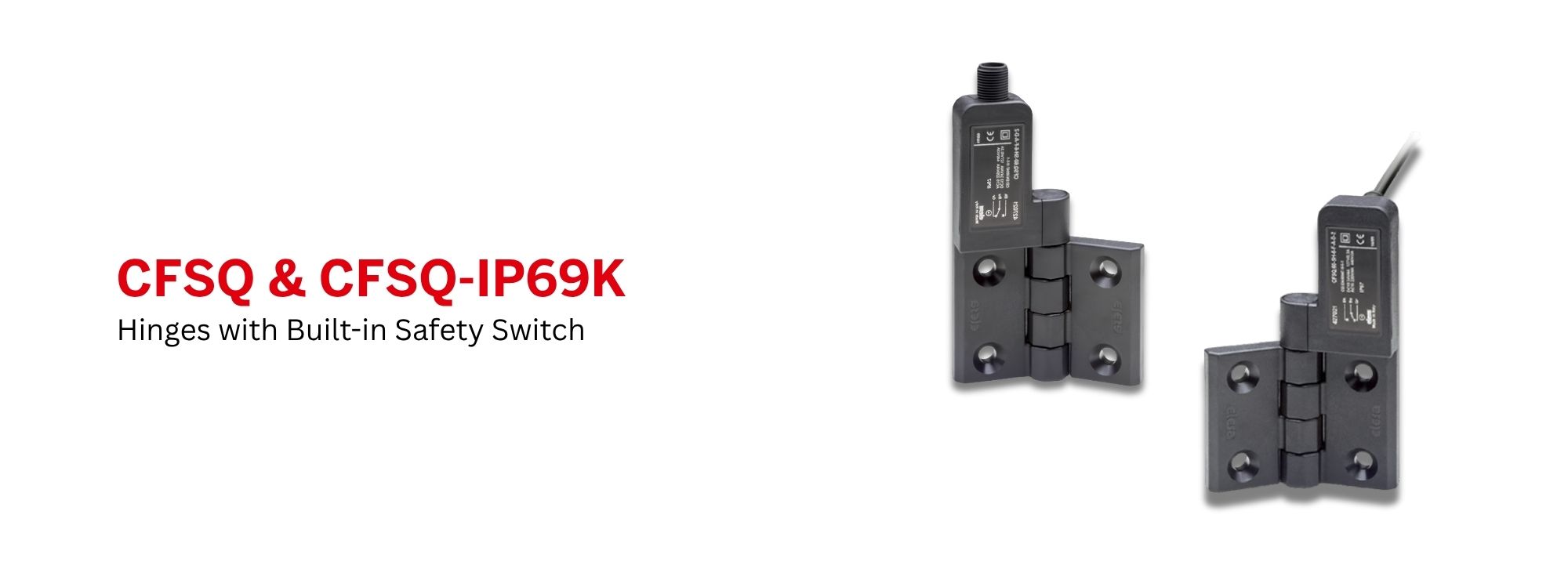
CFSQ addresses this arrangement by integrating the safety switch directly into the hinge. The hinge performs its normal mechanical function while its rotation also actuates the electrical switching mechanism. CFSQ is intended for machine doors, protective guards and safety doors; CFSQ-IP69K provides the same concept with IP69K protection.
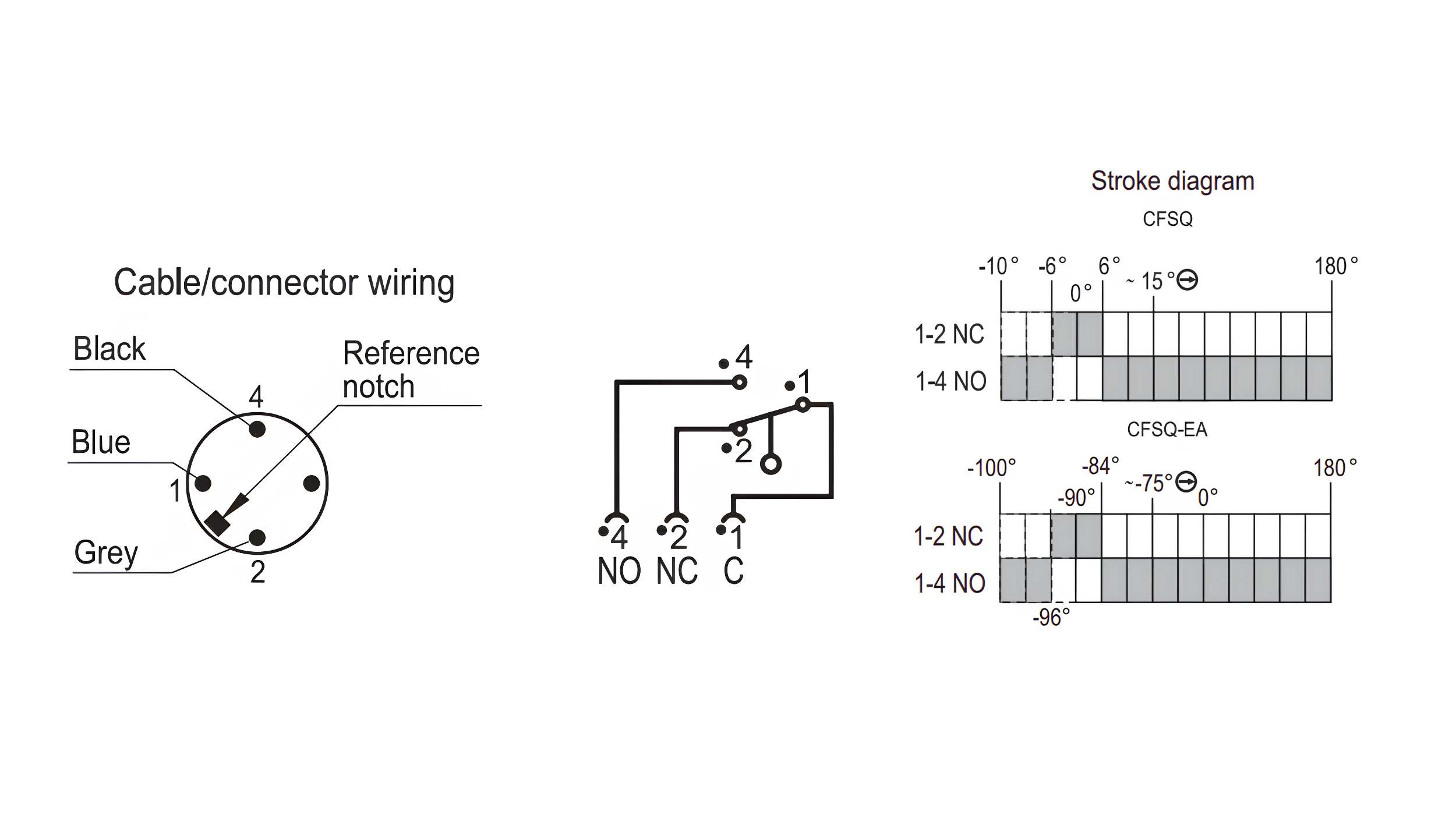
The integrated microswitch has two contacts: one normally closed (NC) contact and one normally open (NO) change-over contact, Form C, in accordance with IEC EN 60947-5-1. The NC contact is used for safety interruption, while the NO contact can provide a door-status signal.
A key feature is positive opening. The electrical contacts are separated through direct actuator movement using non-elastic elements. This means the contact opening follows the mechanical movement of the hinge. The switch is quick-release: contact-holder stroke speed does not depend on door-opening speed.
The nominal switching angle is approximately 6° and can increase to approximately 9° at the end of the specified mechanical life. For positive opening of the contacts, the hinge must rotate by at least 15°. The permitted operating speed is 2°/s to 90°/s.
The hinge with built-in safety switch features an ELESA patent, integrating the mechanical hinge and safety switching function into a single component. This patented arrangement can simplify the design of machine doors and guards by reducing the need for a separate hinge and safety switch arrangement.
The hinge is one component within the machine safety system. Correct circuit design, installation, validation and functional checks remain necessary.
 CFSQ combines the hinge and switch mechanism in one compact body. The standard version has IP67 protection and is suitable for applications involving frequent washing and hygiene requirements.
The hinge uses an AISI 303 stainless-steel rotating pin. Its housing provides double insulation of the internal circuits and protects electrical contacts against shocks, atmospheric agents and accidental tool penetration.
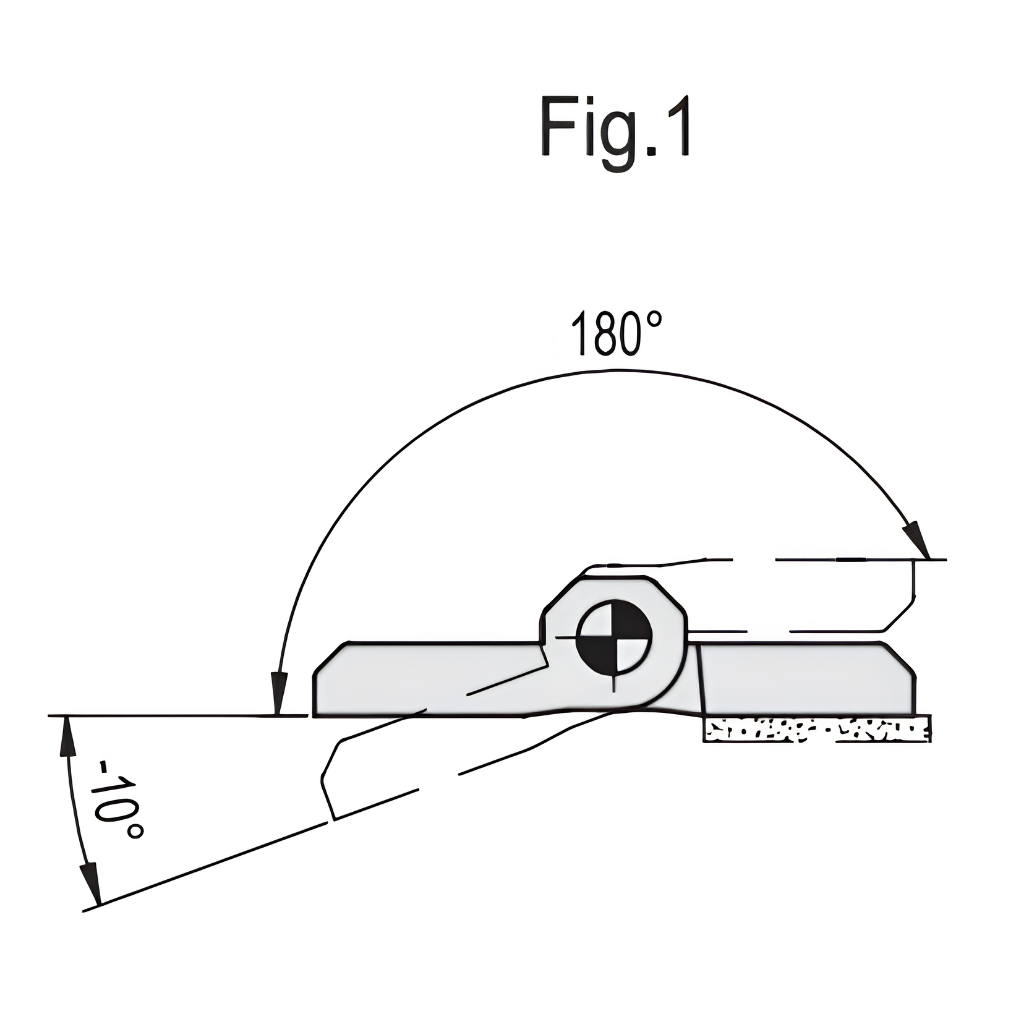
Mounting is through pass-through holes for M6 countersunk-head screws according to UNI 5933/DIN 7991. The hinge can be assembled on common aluminium profiles. Its rotation range is approximately 190°, from -10° to +180°(Fig.1).
Because CFSQ hinges with built-in safety switches can also serve as safety devices, static load ratings are important when checking the mechanical suitability of the hinge for a machine design.
For the CFSQ version, the maximum limit static loads are:
These values are reference maximum static loads obtained under controlled test conditions. A suitable safety factor must be applied according to the importance and safety level of the specific application.
AC15 and DC13 ratings are specified for connector and cable versions and must match circuit requirements.
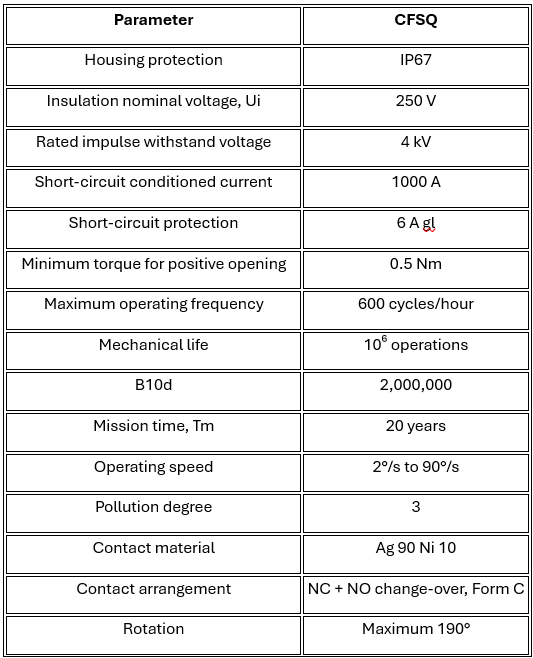
The specified maximum ambient temperature for assembly is 40°C.
The principal difference is enclosure protection. CFSQ is rated IP67, while CFSQ-IP69K is designed for applications requiring IP69K protection.
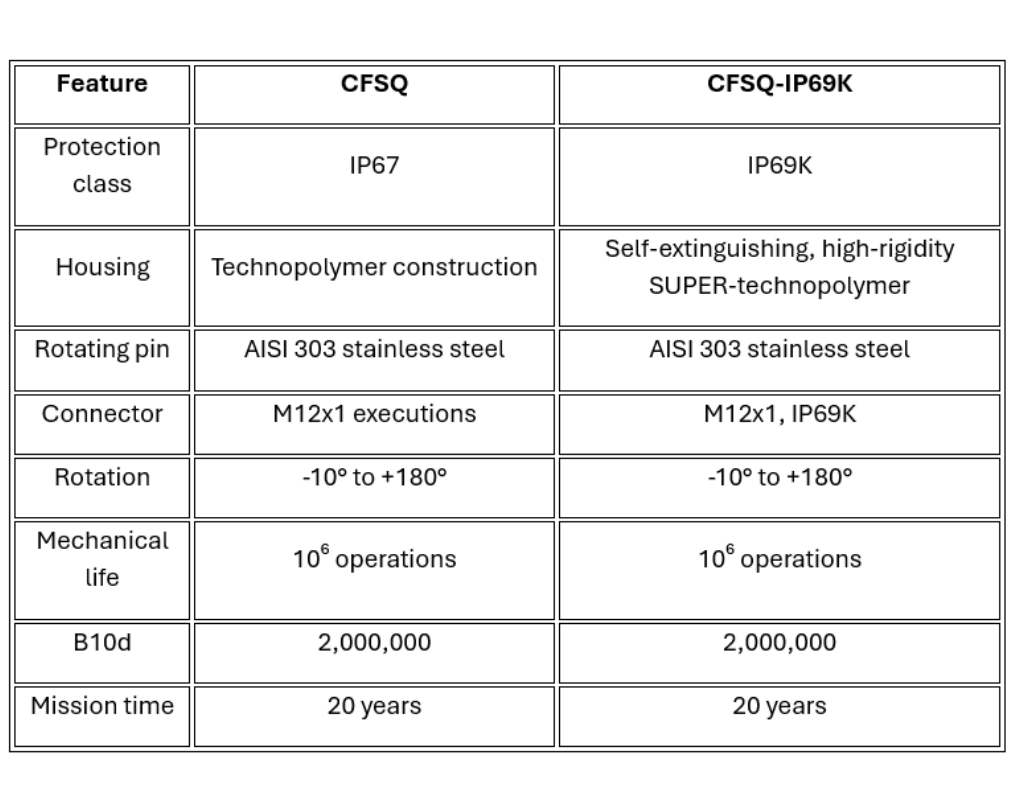
CFSQ-IP69K is intended where the higher protection level is required for demanding washdown conditions.
Configurations allow the connector and microswitch position to suit the machine door arrangement.
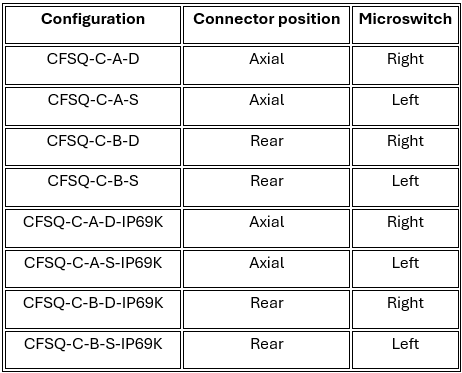
CFSQ-F cable execution: In addition to connector versions, standard CFSQ hinges are available with an integrated 2 m or 5 m cable. The cable execution is available with axial or rear cable positioning and right- or left-hand microswitch positioning.
CFSQ-EA extended-angle version: The CFSQ-EA version is designed for applications requiring a wider rotation range. It has a starting work angle of -90° and an extended rotation angle of up to 270°, from -90° to +180°.
The standard CFSQ versions have a maximum rotation of approximately 190° (-10° to +180°), while the CFSQ-EA versions provide the extended 270° range.
The IP69K versions are identified by codes 427011-IP69K, 427013-IP69K, 427015-IP69K and 427017-IP69K.
CFSQ-IP69K uses an M12x1 connector with axial or rear positioning and right- or left-hand microswitch positioning. Special operating angles, in 15° increments, are available on request.
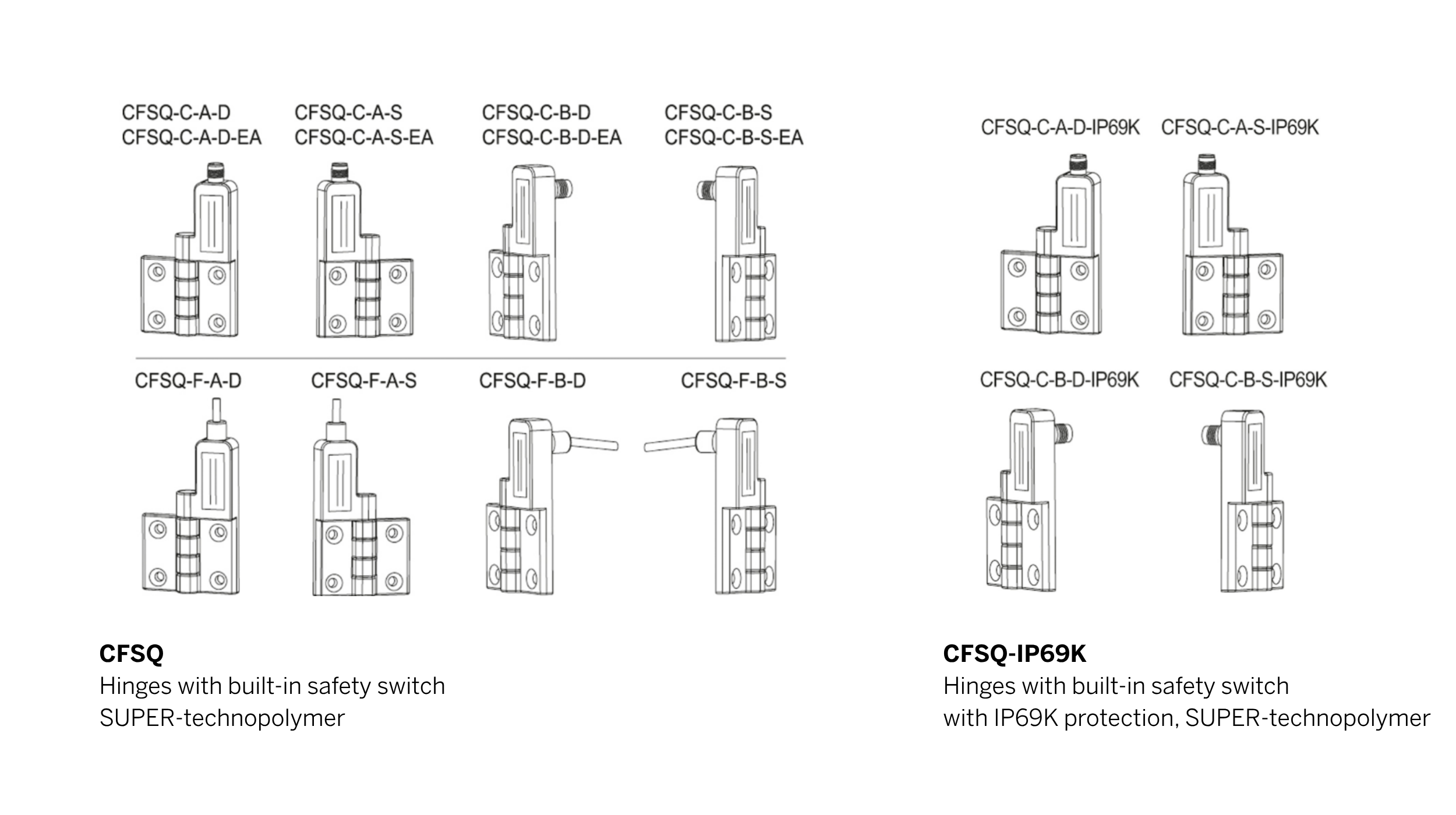
CFSQ is suited to machine doors, protective guards, safety doors and access panels where door movement must be monitored electrically. The integrated arrangement is useful where a separate hinge and safety switch would increase complexity or consume space.
The standard CFSQ, with IP67 protection, suits applications requiring frequent washing. CFSQ-IP69K is intended for demanding washdown conditions requiring IP69K protection.
Installation affects hinge performance and switch operation. The hinge must not be used as a mechanical end stop at the closed or maximum-open position. Separate mechanical stops must be provided.
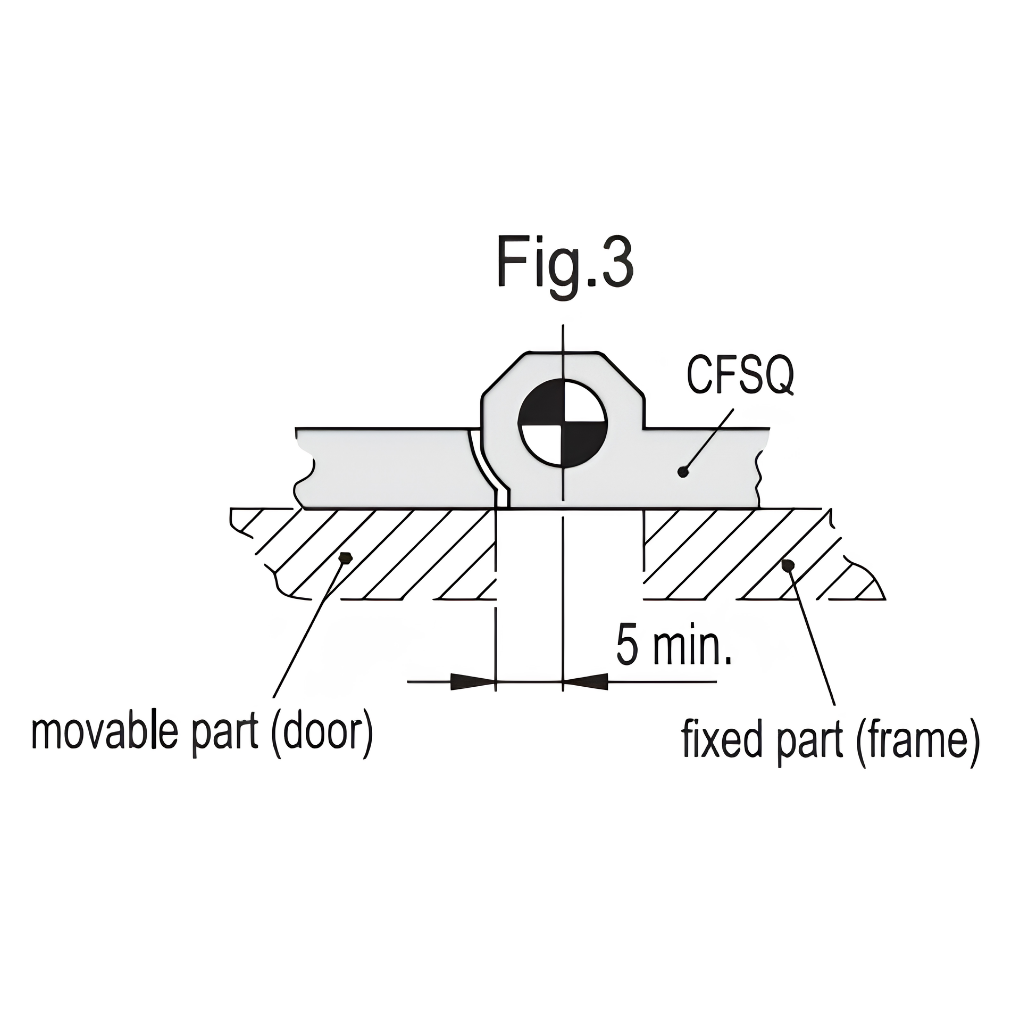 The manufacturer's documentation specifies keeping the clearance between mounting holes and screw diameter to a maximum of 0.5 mm and not exceeding the recommended 5 Nm tightening torque. The distance between the hinge-pin axis and the door must be at least 5 mm(fig.3).
At least one neutral hinge equivalent to CFMQ.60-45-SH-6, code 425812, should be used with CFSQ. One hinge may be sufficient for horizontally opening doors or doors with limited weight.
For CFSQ-IP69K, FC.M12x1 extensions with a four-pole M12 female axial connector are available on request. Wiring must be protected against mechanical damage, with suitable short-circuit protection.
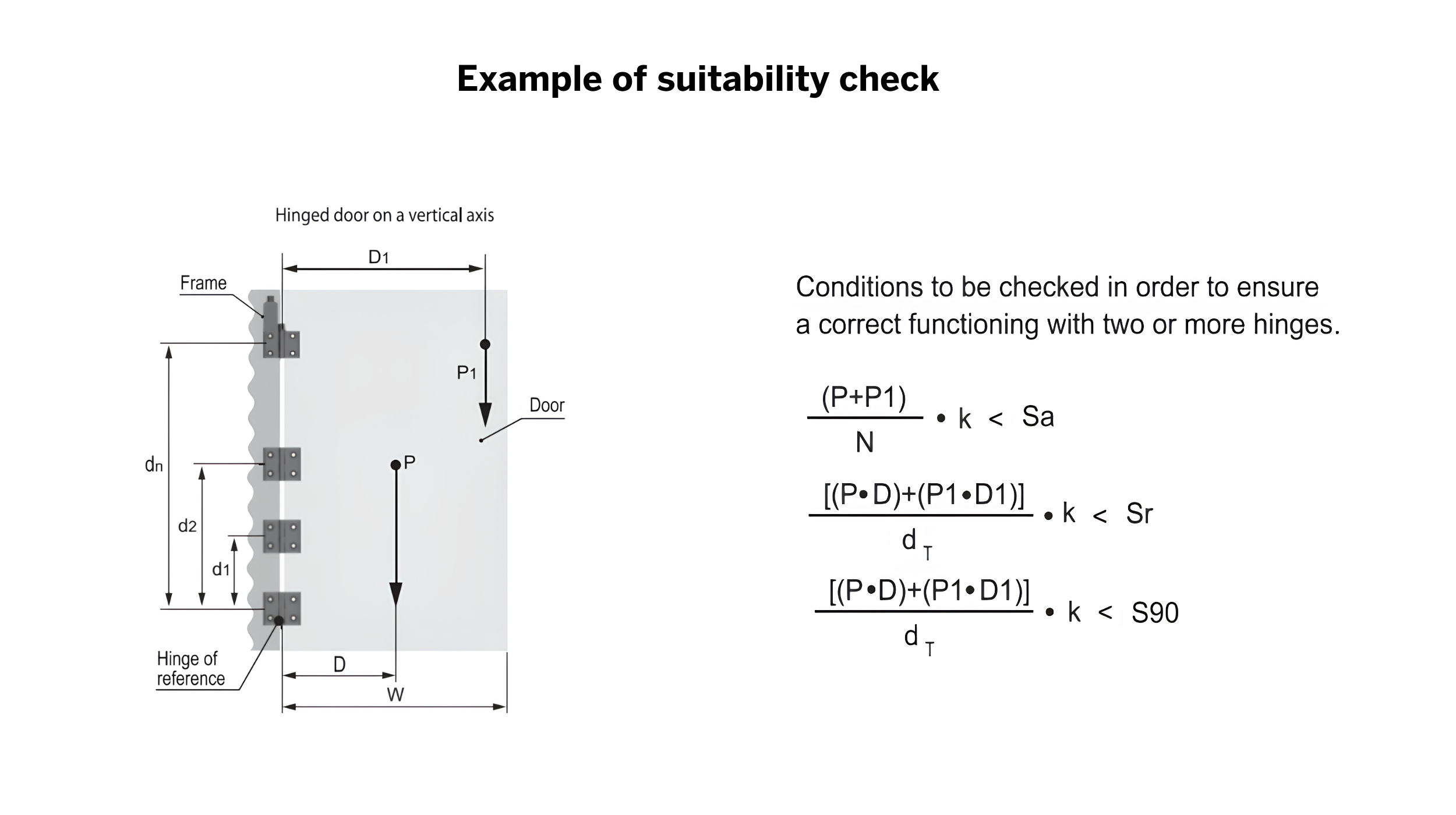
CFSQ hinges must not be used in environments with frequent temperature changes that may cause condensation or where explosive or flammable gases are present. The hinge must be protected with the appropriate fuse and installed and connected by qualified personnel. Selection and use remain the customer’s responsibility, including verification of compliance with applicable safety standards such as EN ISO 13849-1, IEC EN 60204-1, UNI EN ISO 14119 and EN ISO 12100. Regular checks must be carried out to ensure correct operation.
CFSQ demonstrates how mechanical and electrical functions can be integrated into a single machine component. By incorporating the safety switch into the hinge, the system cuts the need for a separate switch actuator arrangement while using the door's natural movement to operate the switching mechanism.
The ELESA-patented design, positive opening characteristics, defined static load capacity, 10⁶-cycle mechanical lifespan, and multiple connector, cable and rotation-angle configurations support integration into machine guarding systems.
The CFSQ-IP69K version extends this approach to applications requiring IP69K protection, while CFSQ-F and CFSQ-EA executions provide additional flexibility for cable routing and extended door rotation requirements.
Selection depends on environmental conditions and required protection level. In both cases, the hinge stays one element of the overall safety system. Mechanical installation, electrical integration, validation and periodic functional checks must be carried out according to applicable machine-safety requirements.