Close

In automated machinery, workpieces must remain securely positioned during machining, welding, assembly and inspection. Manual clamping may be suitable for simple operations, but repetitive production processes require a consistent and controlled approach.
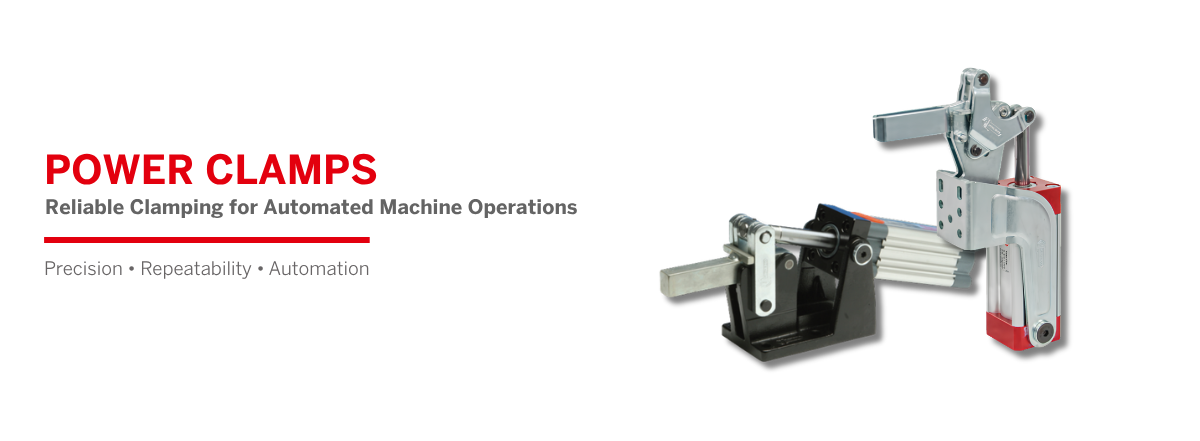
Pneumatic power clamps use compressed air to hold and release workpieces, supporting repeatable operation and integration into automated machine systems. The Elesa+Ganter power clamp range includes different mounting arrangements, clamping mechanisms and construction materials to meet varied application requirements.
These mechanical devices are operated by a pneumatic cylinder. Compressed air moves the cylinder, transferring force through a linkage and clamping arm to secure a workpiece.
Many pneumatic toggle clamps use a toggle mechanism to generate a stable clamping action near the end of the operating stroke. This helps hold components in position during repeated machine cycles.
Depending on the model, power clamps can provide quick movement, different clamping directions, manual operation and end-position monitoring.
Power clamps help address common challenges in automated production and fixture design.
The correct configuration depends on the workpiece, required clamping force, available space and operating conditions.
For demanding applications, the GN 861 and GN 863 feature cast-steel bodies and hardened bearing components. The GN 962 Longlife series uses reinforced construction with hardened and ground bearing pins and bushings for applications requiring mechanical durability.
The GN 8620 aluminium power clamps are designed for holding and positioning components in automated welding, transfer and mounting mechanisms. Their quick swivel movement supports efficient machine cycles, while compatible sensing arrangements provide position feedback.
The GN 8621 adds a manual operating option, which can assist with setup and troubleshooting.
The GN 864 has a horizontal clamping arm, while the GN 865 uses a vertical arm. Both feature steel C45 construction and are suitable for applications requiring robust mechanical clamping.
The GN 866 uses two vertical arms that move inward towards the workpiece. This arrangement supports centred clamping when forces need to be applied from opposite sides.
The GN 890 uses a pneumatic push-toggle mechanism with a horizontal mounting base. Its forged steel body and hardened bearing components support demanding mechanical applications.
The selection of a power clamp should reflect the actual task being performed. The following examples illustrate how different configurations can be used in industrial equipment.
During welding, sheet-metal parts must remain in the correct position to maintain dimensional consistency and prevent movement. Pneumatic power clamps can hold components securely while welding operations are performed.
Suitable consideration: GN 8620 for automated welding and positioning applications. Where welding spray is present, appropriate protective features and compatible clamp configurations should be evaluated.
During drilling, milling or other machining operations, a workpiece must remain stable under the forces generated by the process. Pneumatic toggle clamps can automate the holding and release of components between machining cycles.
Suitable consideration: GN 860 or GN 862, depending on whether a horizontal or vertical mounting base is required. Clamping force and fixture rigidity must be verified for the machining operation.
Assembly equipment often requires components to remain in position while fasteners, fittings or other parts are installed. Pneumatic clamps can hold components during the assembly sequence and release them when the operation is complete.
Suitable consideration: GN 862 or GN 862.1, depending on mounting requirements and whether manual operation is beneficial during setup.
Components moving through automated production lines may need to be held at specific points for positioning, transfer or mounting. Swivelling power clamps can provide controlled clamping and release within the machine sequence.
Suitable consideration: GN 8620 or GN 8621, subject to workpiece geometry, required force and the available installation space.
Some fixtures require a component to be secured from two opposing sides. A centred clamping arrangement can help apply forces towards the middle of the workpiece.
Suitable consideration: GN 866, which uses two vertical clamping arms for inward clamping.
Fixtures operating under demanding mechanical conditions require suitable strength and wear resistance. Robust steel construction and hardened bearing components can support repeated operation when correctly selected and maintained.
Suitable consideration: GN 861, GN 863 or GN 962, depending on the required clamping performance and application conditions.
These examples are selection guidelines. The final model should be confirmed against the manufacturer's technical data and the actual application requirements.
The range includes the following configurations:
The range includes model-specific accessories for clamping, mounting, alignment and position monitoring. Check the compatibility of each accessory against the selected clamp model.
Key accessory series include:
Other accessories: Clamping screws, clamping-screw holders, connector cables, protective covers such as GN 864.1, and dowel pins are available for selected models.
Consider these factors before choosing a pneumatic power clamp:
Operating pressure limits vary by model. Several pneumatic toggle clamps specify a maximum of 6 bar, GN 8620 and GN 8621 operate within a 2–8 bar range, and GN 864, GN 865 and GN 866 specify a maximum of 10 bar.
Clamping performance also depends on lever geometry and stroke position. Correct fixture design and workpiece positioning are essential to achieve the required holding force safely and consistently.
Pneumatic power clamps provide controlled and repeatable workpiece holding for automated machinery, welding fixtures, machining stations and assembly systems. The Elesa+Ganter range covers aluminium and steel constructions, heavy-duty designs, manual-operation options and centred clamping configurations.
Selecting the right clamp requires matching its mechanical design, clamping force, operating pressure and mounting arrangement to the application. A correctly specified system can support consistent positioning, efficient machine cycles and reliable long-term operation.
Technical data sheets, dimensional drawings, and 3D CAD files for Power Clamps are available from elesa-ganter.in. For specification support and lead-time information, contact at offers@elesa-ganter.in
Headquarter: marketing@elesa-ganter.in | +91-120-4726666