Main specifications
Material
Glass-fibre reinforced polyamide based (PA) technopolymer, black colour, matte finish.
Rotating pin
AISI 303 stainless steel.
Standard executions
Resistant torque 1.5 or 3 Nm.
- CFV-SH: pass-through holes for countersunk head screws.
- CFV-EH: pass-through holes for hexagonal head screws.
General information
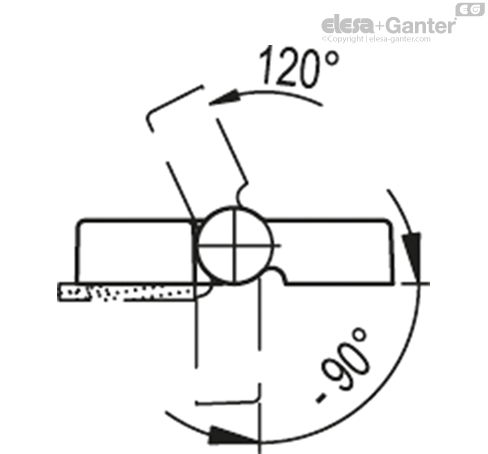
Rotation angle (approximate value)
Max 210° (-90° and +120° being 0° the condition where the interconnected surfaces are on the same plane).
Do not exceed the rotation angle limit so as not to prejudice the hinge mechanical performance.
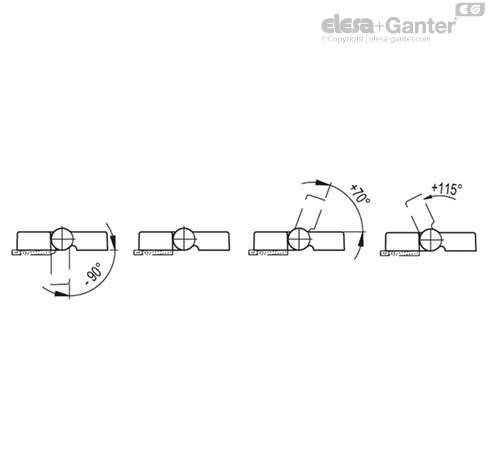
The detent device (ELESA patent) allows four different detent positions of the door (-90°, 0°, +70°, +115°).
To choose the convenient type and the right number of hinges for your application, see the Guidelines.
Resistant torque
All detent positions guarantee a resistant torque of about 1.5 or 3 Nm (which is the torque that must be applied to free the detent device of the hinge).
The hinge had been tested with more than 20.000 opening and closing cycles and the value of the resistant torque was unchanged.
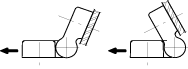
| Resistance tests | AXIAL STRESS | RADIAL STRESS | 70° AND 115° ANGLED STRESS | 90° ANGLED STRESS |
 |  |  |  |
| Description | Maximum working load
Ea [N] | Load at breakage
Ra [N] | Maximum working load
Er [N] | Load at breakage
Rr [N] | Maximum working load
E70 and E115 [N] | Load at breakage
R70 and R115 [N] | Maximum working load
E90 [N] | Load at breakage
R90 [N] |
| CFV.65 SH-6 | 1320 | 4480 | 2070 | 5060 | 2150 | 3170 | 1630 | 3380 |
| CFV.65 EH-6 | 1520 | 3840 | 1940 | 4900 | 1430 | 3660 | 970 | 3140 |